![]() |
![]() |
Cheheltan at the Herbert Read Gallery |
![]() |
|||
![]() |
![]() |
||||
![]() |
![]() |
||||
![]() |
![]() |
||||
![]() |
![]() |
![]() |
![]() |
![]() |
![]() |
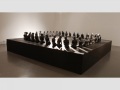
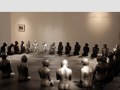
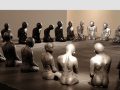
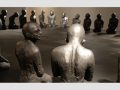
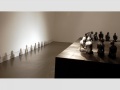
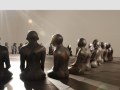
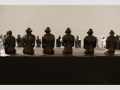
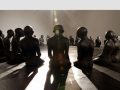
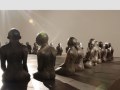
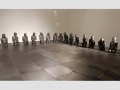
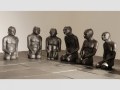
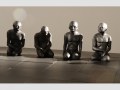
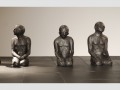
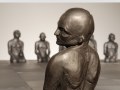
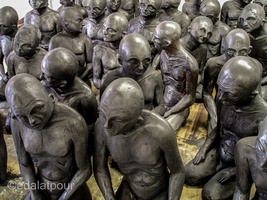
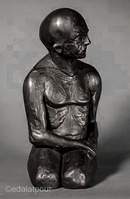
Cheheltan 2005 Patinaed plaster cast, Height of each figure 350mm Platform size: 42000mm X 42000mm Cheheltan is a group of forty figure placed upon slate platform. The figures are all in seated position but they are distinct in feature and body formation. The figures do vary in size and proportion and are slightly animated. The movement of hands and heads become particularly significant in the group composition. The seated position which all the figures share is the way one seats on a Persian carpet, indeed the gathering of the figures simulates many social occasions across the Middle East. The word Cheheltan is a Persian word for forty-some or forty people. There are a few places in Iran and Afghanistan that are called Chehel Tanan, namely a mausoleum in Shiraz which relates to Karim Khan Zand period and in this place forty tomb stones can be observed. These belong to forty Gnostics. The grouping of these figures creates a quiet narrative and a silent conversation. The piece allows for variation in the grouping of the figures and therefore the narrative is not fixed. Cheheltan was first exhibited at the Herbert Read Gallery in Canterbury, England in October 2006. The concept of Cheheltan originates first in the journey of si-murgh in the book of Mantiq al-tayr (The Conference of the Birds) which was written by the twelfth century Persian poet, Farid ud-Din Attar. It is a conversation, a gathering and an adventure which take the protagonists to the Mountain of Qaf, a conceptual place where the possibility of the return is promised. "NA-KOJA-ABAD” provides the second source of inspiration and the framework for Cheheltan. It is a an idea which was first mentioned by Sohravardi the Twelfth century Persian philosopher, In the tale entitled " The Rustling of Gabriel's Wings," a figure appears and he is asked the question “Where he is from”, and the reply is this: "I come from Na-koja-Abad." Na-koja-Abad is a strange term. It does not occur in any Persian dictionary, and it was coined by Sohravardi himself, from the resources of the purest Persian language. It signifies the city, the country or land (abad) of No-where (Na-koja). |
| Home | Bibliography | Sculpture | Drawing |   E-mail |